


Syllabus: GS3/Defence; GS1/Women Empowerment
Context
- On International Women’s Day (8 March), the expanding leadership and operational roles of women in the Indian Armed Forces highlight their growing contribution to national defence and gender equality.
Historical Trajectory of Women in India’s Defence Services
- The role of women in India’s defence services has evolved steadily from limited support functions to increasingly diverse operational and leadership positions.
- Pre-independence:
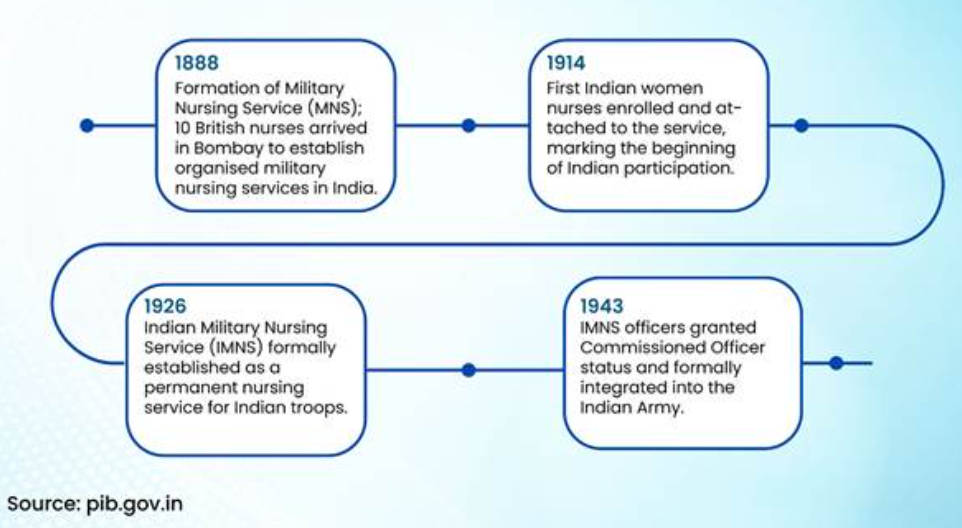
- Post-independence:
- In 1958, for the first time, women doctors were granted Regular Commissions in the Army Medical Corps on the same terms as men.
- In 1992, the armed forces opened officer-level entry to women. The Indian Army introduced the Women Special Entry Scheme (WSES), enabling women to serve in non-combat branches and extending eligibility to widows of personnel killed in action as a compassionate measure. Parallel progress also occurred in the Indian Navy and the Indian Air Force.
Importance of Women in Armed Forces
- Expands the Talent Pool: Women constitute roughly 4–5% of officers in the Army, 6–7% in the Navy, and 13–14% in the Air Force, the highest among the three services.
- Community Engagement: Women peacekeepers often improve communication with local populations, particularly with women and children in conflict zones. India deployed the first all-women police unit to Liberia in 2007 under United Nations Peacekeeping, which strengthened trust with local communities.
- Enhances Operational Capability: Studies by the United Nations indicate that gender-diverse security teams improve operational performance, problem-solving, and decision-making.
- Reflects Global Military Trends: In many countries—including the United Kingdom, France, Australia, Germany, Japan, South Korea, and Turkey—women can pursue careers across various military roles, reflecting the growing global recognition of gender inclusivity in defence institutions.
- Inspiration: Women personnel increasingly serve as role models for future generations. Officers such as Sophia Qureshi and Vyomika Singh gained national attention during Operation Sindoor, highlighting the expanding role of women in India’s defence forces.
Awards and Recognitions
- UN Recognition (2023): Radhika Sen was named the “Military Gender Advocate of the Year 2023” by the United Nations, acknowledging her contribution to gender-sensitive peacekeeping.
- UN Secretary-General’s Gender Award (2025): Major Swathi Shanthakumar received the UN Secretary-General’s Award (Gender Category) for her work under the “Equal Partners, Lasting Peace” initiative during her service with the United Nations Mission in South Sudan.
- Army Day Awards (2025): The National Cadet Corps girls’ contingent received recognition for marching in theIndian Army Day Parade, reflecting institutional acknowledgment of women’s expanding participation.
Major Policy Reforms/Milestones
- Kargil Review Committee (1999): Recommended expanding women’s roles in logistics, engineering, and intelligence within the armed forces.
- Supreme Court of India Judgment (2020): Directed the grant of Permanent Commission to women officers in the Indian Army, strengthening career prospects and gender equality.
- Agnipath Scheme (2022): Enabled the entry of women as Agniveers across the Army, Navy, and Air Force.
- Entry into the National Defence Academy: Women cadets were admitted following judicial intervention, with the first batches graduating in 2025.
- Rising Strength: The number of women officers across the three services has increased from around 3,000 in 2014 to over 11,000, reflecting expanding opportunities and institutional reforms.
- Military Nursing Service: Remains the only all-women corps within the armed forces.
Challenges Faced
- Limited Combat Roles: While many countries, including Germany, France, Israel, and Australia, permit women in combat positions, their induction into core combat arms in India remains gradual. In the IAF, the experimental scheme launched in 2015 to induct women officers into the fighter stream was regularised and made permanent in 2022.
- Infrastructure gaps: Lack of gender-sensitive facilities in remote or field postings can hinder full integration.
- Career progression concerns: Historically, women officers faced limitations in long-term command opportunities due to earlier short-service commission policies.
- Cultural and Social Resistance: Traditional mindsets may pose challenges in acceptance and integration within military ranks.
Way Forward
- Women’s participation in the Indian Armed Forces has expanded from medical and nursing roles to diverse operational and leadership positions. Continued progress requires:
- Expanding command and leadership opportunities for women officers.
- Improving infrastructure and support systems in field areas.
- Strengthening training and mentorship programmes.
- Ensuring policy reforms aligned with the constitutional spirit of Article 15 of the Constitution of India, which prohibits discrimination on the grounds of sex.
Source: PIB
Previous article
India’s ‘leaky pipeline’ Problem
Next article
From Women’s Development to Women-led Development
